
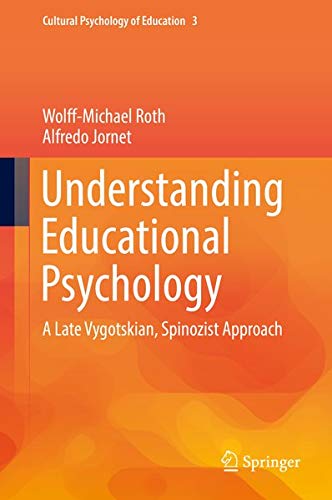
Understanding Educational Psychology: a late vygotskian, spinozist approach
Material type: TextPublication details: Switzerland Springer 2017Description: xiv,327p. 24 cmISBN:
 - 9783319398686
- Culture, Difference (Psychology), Education / Educational Psychology, Education / General, Education / Philosophy, Theory & Social Aspects, Educational psychology, Educational sociology, Personality, Psychology / Applied Psychology, -- Psychology / Personality, Social Science / Anthropology / Cultural & Social, Social Science / Sociology / General, Social Science / Sociology of Religion, Education, Religion and culture, Social psychology
- LB 1050.9 JOR 2017
| Cover image | Item type | Current library | Home library | Collection | Shelving location | Call number | Materials specified | Vol info | URL | Copy number | Status | Notes | Date due | Barcode | Item holds | Item hold queue priority | Course reserves | |
|---|---|---|---|---|---|---|---|---|---|---|---|---|---|---|---|---|---|---|
| Books | Ziauddin School & College Library On Shelve | LB 1050.9 JOR 2017 (Browse shelf(Opens below)) | Available | 133 EDU |
Browsing Ziauddin School & College Library shelves,Shelving location: On Shelve Close shelf browser (Hides shelf browser)

|

|

|

|
No cover image available |

|

|
||
| LB 1028 MIL 2007 Action Research: a guide for the teacher researcher | LB 1028 WEL 1994 Changing Schools From Within Creating Communities of Inquiry | LB 1031 CAR 2013 Assessment and Student Success in a Differentiated Classroom | LB 1050.9 JOR 2017 Understanding Educational Psychology: a late vygotskian, spinozist approach | LB 1051 BRU 1987 Educational Psychology: principles and applications | LB 1139 MIN 2006 Teaching young children social studies | LB 1555 POL 2008 Reflective Teaching: |
Includes index
This book takes up the agenda of the late (but unknown) L. S. Vygotsky, who had turned to the philosopher Spinoza to develop a holistic approach to psychology, an approach that no longer dichotomized the body and mind, intellect and affect, or the individual and the social. In this approach, there is only one substance, which manifests itself in different ways in the thinking body, including as biology and culture. The manifestation as culture is premised on the existence of the social.
In much of current educational psychology, there are unresolved contradictions that have their origin in the opposition between body and mind, individual and collective, and structure and process—including the different nature of intellect and affect or the difference between knowledge and its application. Many of the same contradictions are repeated in constructivist approaches, which do not overcome dichotomies but rather acerbate them by individualizing and intellectualizing our knowledgeable participation in recognizably exhibiting and producing the everyday cultural world. Interestingly enough, L. S. Vygotsky, who is often used as a referent for making arguments about inter- and intrasubjective “mental” “constructions,” developed, towards the end of his life, a Spinozist approach according to which there is only one substance. This one substance manifests itself in two radically different ways: body (material, biology) and mind (society, culture). But there are not two substances that are combined into a unit; there is only one substance. Once such an approach is adopted, the classical question of cognitive scientists about how symbols are grounded in the world comes to be recognized as an artefact of the theory. Drawing on empirical materials from different learning settings—including parent-child, school, and workplace settings—this book explores the opportunities and implications that this non-dualist approach has for educational research and practice.
There are no comments on this title.